Designing a Magical Reading Habit for Kids
My role
Product Designer — end-to-end, from discovery to delivery and repeat.
Team
2 Product designers, PM, 4 Engineers, 2 Marketing, 1 Content and CEO.
Company
AI-powered personalized stories for kids and families.
Delivery
Once upon a time…
A world where reading is always the first choice for children.
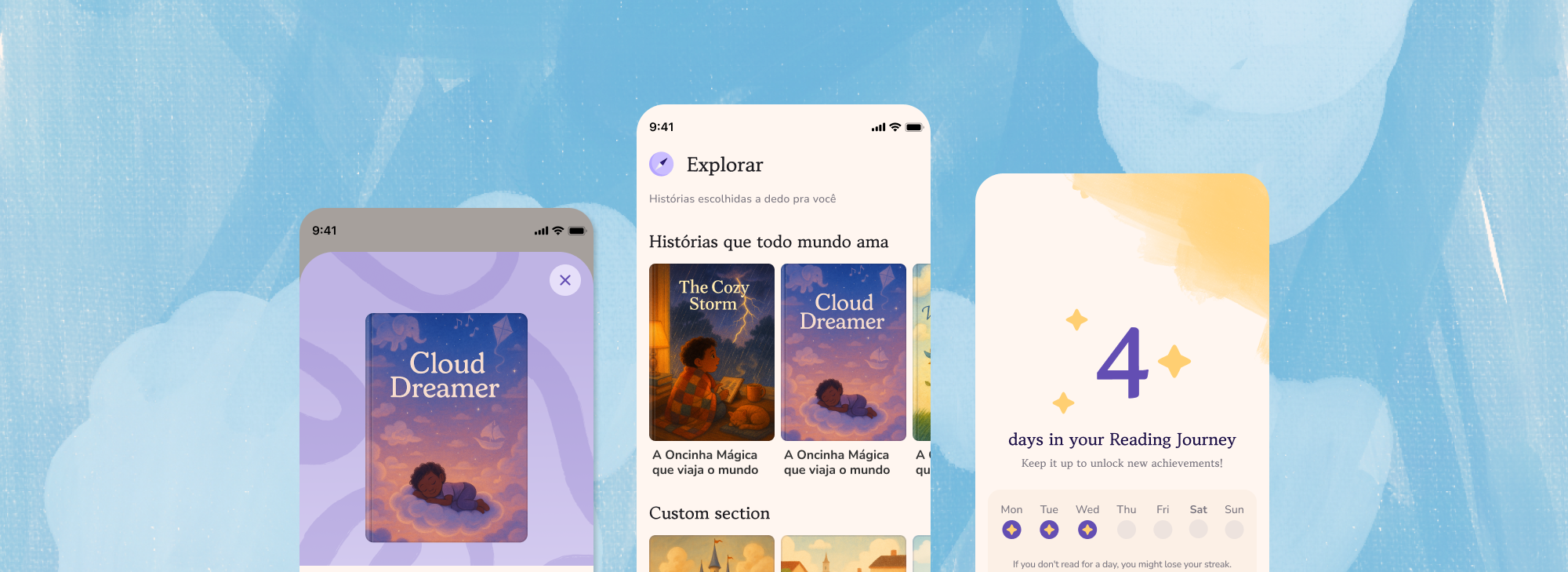
Explore
Recommended stories
Titles that speak the family's language. Visual cards with illustration like book covers and short descriptions, so kids can help choose!
Create Story
Turning personalization into a playful moment
Reduced the number of steps while keeping the most meaningful choices. Micro-interactions to keep kids engaged while the story is being generated.
Read Story
A calm, comfortable and magical reading environment
Voice over, play/pause animation and font setup to keep the story "alive" without distracting — so both adults and kids can read easily.
Daily streak
Celebration screen with a gentle motivation after reading
A simple, friendly calendar showing consecutive reading days. Copy focused on celebration, not pressure. Forgiveness mechanics so missing a day never feels like failure.
Why don't families read with Yuna every day?
Parents loved the idea of personalized stories, but that didn't automatically turn into a consistent reading habit. Yuna creates personalized stories where kids get to become the heroes — but one question shaped the entire challenge: if families love the stories, why aren't they reading every day?
Daily reading sounds simple, but real family routines are messy. Parents are tired, kids are excited, bedtime is unpredictable, and technology can either support that moment or add friction. My goal was to design an experience that feels light for parents, magical for kids, and sustainable for both.
Low repeat usage
Many families read only once or twice after activation.
Drop-offs during creation
Parents felt the flow was "too many steps" or weren't sure what would come next.
No clear habit loop
Reading needed to become part of the family routine, not just a one-off "wow" moment.
Every choice needs to feel meaningful
Qualitative research (interviews, feedback), research on children's behavior, and quantitative data (analytics) to understand why families weren't forming a reading habit. COPPA compliance shaped how we collected and handled all children's data.
The reading experience drives everything. Comfort, typography, pacing, and simplicity matter more than any feature.
Motivation must feel gentle, not gamified. The magic disappears when there are too many steps.
Children want to interact more with Yuna. The experience needs to work without overwhelming parent or child.
Families need clarity, speed, and a little bit of magic.
Three design principles
Clarify the journey
Parents don't have time for guesswork, kids don't have patience for friction. Reshaped the flow into a clean, predictable loop: Explore → Choose → Personalize → Read → Celebrate → Come back tomorrow. Predictability removes cognitive load and reduces drop-offs.
Design for co-use
A child tapping excitedly + a parent navigating quickly = chaos unless the UI is built for it. Big touch areas, simple expressive visuals, interactions stable under "enthusiastic tiny taps", flow length optimized for bedtime energy levels.
Motivate without pressure
Streaks should feel like a warm celebration, not a scoreboard. Gentle and encouraging copy, visuals that focus on today's joy, not tomorrow's obligation, and forgiveness mechanics for breaks.
Designing for families requires balancing competing needs
Depth vs. Simplicity in personalization
Challenge
Too many steps slowed parents, too few diminished the magic for kids.
Decision
Reduce fields to only the emotionally meaningful ones.
Trade-off
Collaborated with content to preserve narrative diversity despite fewer inputs.
Outcome
A faster flow that kept the "I'm the hero!" moment alive.
Calm reading vs. Visual delight
Challenge
Kids love animations but parents need a calm, focused reading moment.
Decision
Use soft, subtle animations that enhance without distracting.
Trade-off
Balance visual charm with a soothing reading environment.
Outcome
A calm space for parents, a magical world for kids.
Motivation vs. Emotional pressure
Challenge
Streaks motivate kids but can create guilt for busy families.
Decision
Use gentle, celebratory language — never punishment.
Trade-off
Engage without pushing families beyond their real routines.
Outcome
Little Stars! Healthy motivation that feels uplifting, not demanding.
Ideal reading time vs. Real-life routines
Challenge
Bedtime is chaotic — parents are tired, kids unpredictable.
Decision
Design a journey that works in just a few minutes.
Trade-off
Shorter sessions with smart pacing to keep stories meaningful.
Outcome
A reading ritual families can actually fit into daily life.
When clarity and magic work together, families keep reading
Although I can't share full internal metrics, early results after launch showed clear improvements in reading consistency.
More stories finished per session.
Meaningful improvements in week-1 retention among users who saw the streak experience.
Noticeable reduction in drop-offs during the personalization flow.
Parents reported the experience felt "magical and lighter for everyday use".
Children began initiating reading sessions by asking to check their streak.
The new reading environment was described as "calmer and more comfortable".
Lessons from building a habit, not just a feature
Designing for kids means designing for adults too.
Children rarely navigate the experience alone — their reading habit is mediated by a parent's time, energy, and emotional bandwidth. A design that works for kids but burdens adults will not sustain a long-term habit. The real challenge is creating moments that feel light and joyful for both, even at the end of a busy day.
Motivation must be ethical and emotionally safe.
Streaks are a powerful behavioral mechanic, especially for children who love collecting and celebrating progress. But they must respect the natural rhythms of family life. Healthy motivation celebrates presence without punishing absence, supports autonomy, and avoids guilt-based loops. Designing for children carries an added layer of responsibility — the product must uplift, not pressure.
End-to-end thinking is what builds habits, not isolated features.
A reading habit isn't created on a single screen; it emerges from the seamless orchestration of small moments across the journey: how quickly families find a story, how magical personalization feels, how calm the reading environment is, and how they are welcomed back the next day. Every touchpoint either reinforces or breaks the habit.
Great design only happens when product, engineering, and content build together
I was the Product Designer responsible for leading the end-to-end experience, working closely with a cross-functional team. While I drove the vision, UX strategy, and design execution, this project was a deeply collaborative effort.
Research & Strategy
- Led interviews with 12 families to understand routines, barriers, and motivations
- Collaborated with Data to interpret behavioral patterns and identify habit-formation opportunities
- Defined the strategic question: "What prevents families from reading on Yuna every day?"
- Conducted an in-depth study on child cognitive development and children learning phases
Experience Design
- Designed the full journey: Choose → Personalize → Read → Celebrate → Return tomorrow
- Co-created personalization logic with the writing/content team
- Defined the streak experience including behavioral logic, microcopy, and ethical motivation principles
UI & Design System
- Redesigned the reading interface with emphasis on comfort and rhythm
- Refined typography, spacing, and visual hierarchy for adult–child co-reading
- Built reusable components and documented states, edge cases, and rules
- Built variables structure on Figma to enable Tablet view
Validation & Delivery
- Facilitated usability tests with families alongside PM
- Conducted perception tests about the feeling of magic on the app
- Delivered detailed specs and implementation guidance
- Feature launch with A/B testing and satisfaction metrics tracking