Daki & Jokr Migration
How we migrated 100% of the user base in 16 weeks without compromising core metrics.
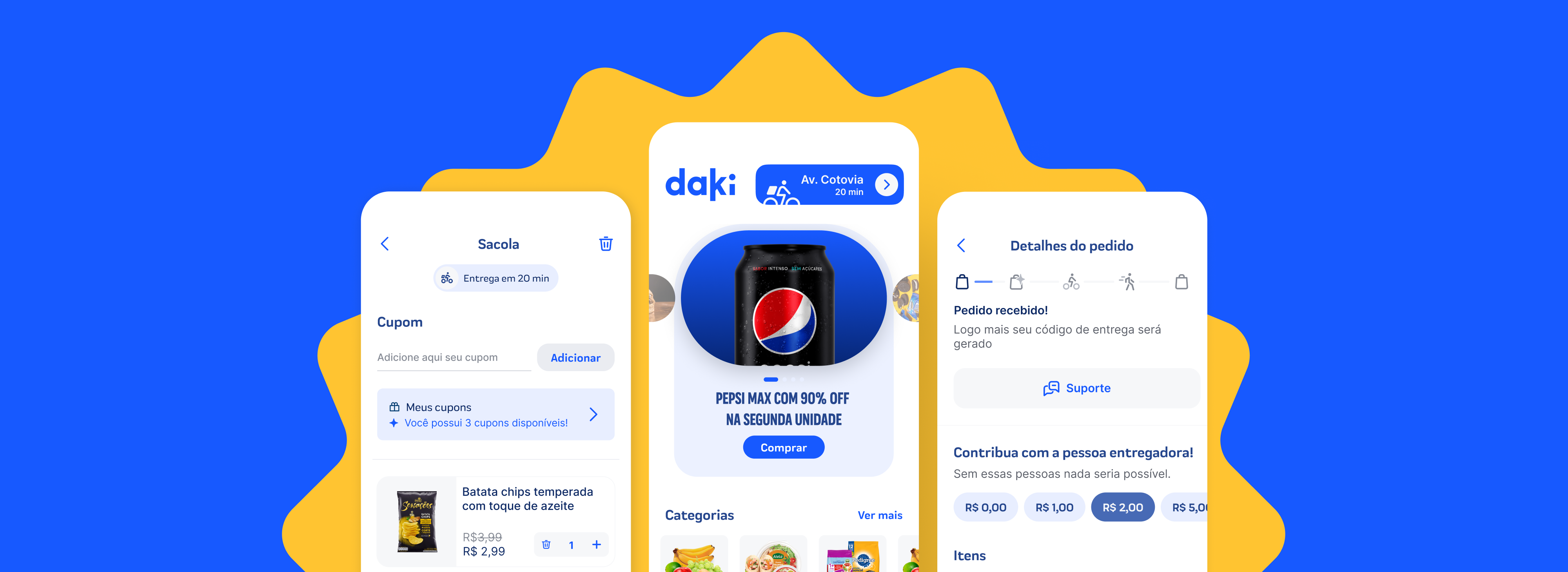
In 2022, Daki and Jokr joined forces, consolidating into one company. We had two live apps, two tech stacks, two design systems — and three hard goals:
This was not a redesign. It was a business-critical migration.
The challenge was not visual alignment — it was behavioral continuity.
I was responsible for defining migration principles, prioritizing critical flows, aligning trade-offs, and creating the new Daki app experience — working alongside 5 Daki engineers, 32 Jokr consultants, 3 VPs and 2 CTOs.
We worked in weekly milestones instead of sprints to maintain decision velocity.
How might we
Converge two active ecosystems without breaking the behaviors that drove revenue?
Protect Revenue-Critical Flows First
We mapped both apps flow by flow, built a customer hierarchy tree, and created a critical vs. trivial prioritization matrix.
Critical flows
- Explore
- Product Details
- Cart
- Coupons
Trivial flows
- Onboarding
- Menu
- Settings
This allowed us to focus engineering capacity where revenue was generated, reduce risk exposure, and sequence delivery strategically.
Preserve Familiar Patterns When Trust Was at Risk
Jokr had stronger personalization. Daki had stronger purchase clarity. Rather than picking a winner, we chose to:
- Maintain Daki's explore architecture
- Keep predictable navigation patterns, including coupon insertion at multiple journey points
- Restructure revenue-critical flows like cart and checkout
Trade-off: We prioritized familiarity over innovation.
Optimize for Two High-Value User Segments
Instead of designing for the average user, we optimized for users who generated the majority of revenue.
High Value Price Seekers
Heavily driven by coupons and promotions
High Value Users
Frequent, high-AOV orders
This shaped coupon logic, cart clarity, promotion visibility, and personalization structure — as well as our usability testing approach. We conducted moderated tests with heavy users from these segments, achieving a satisfactory Cronbach's Alpha for reliable perception data.
Visual Identity Convergence
We performed a full color palette analysis and alias token definition aligned with usage guidelines, creating new components to address evolving product needs — without fully adopting Jokr's visual system.
The new Daki app experience
- Home is now the core experience
- Jokr's seasonal personalization integrated
- New coupon system
- New floating tab bar with emphasis on the cart
- Restructured navigation hierarchy and app-level information architecture
Checkout conversion was preserved throughout the migration. Add-to-cart rate increased significantly. The migration was completed without revenue disruption.
What we chose not to do
- We did not fully adopt Jokr's visual system
- We postponed non-revenue features
- We limited experimentation during the migration phase
Design impact is about organizing decisions
Alignment reduces risk more than aesthetics
Speed requires clarity, not shortcuts
This project strengthened my ability to balance metrics and user experience, influence cross-functional stakeholders, make trade-offs under constraint, and protect business performance during change.